Smart Factory ≠ More Apps: What 2025 Taught Me
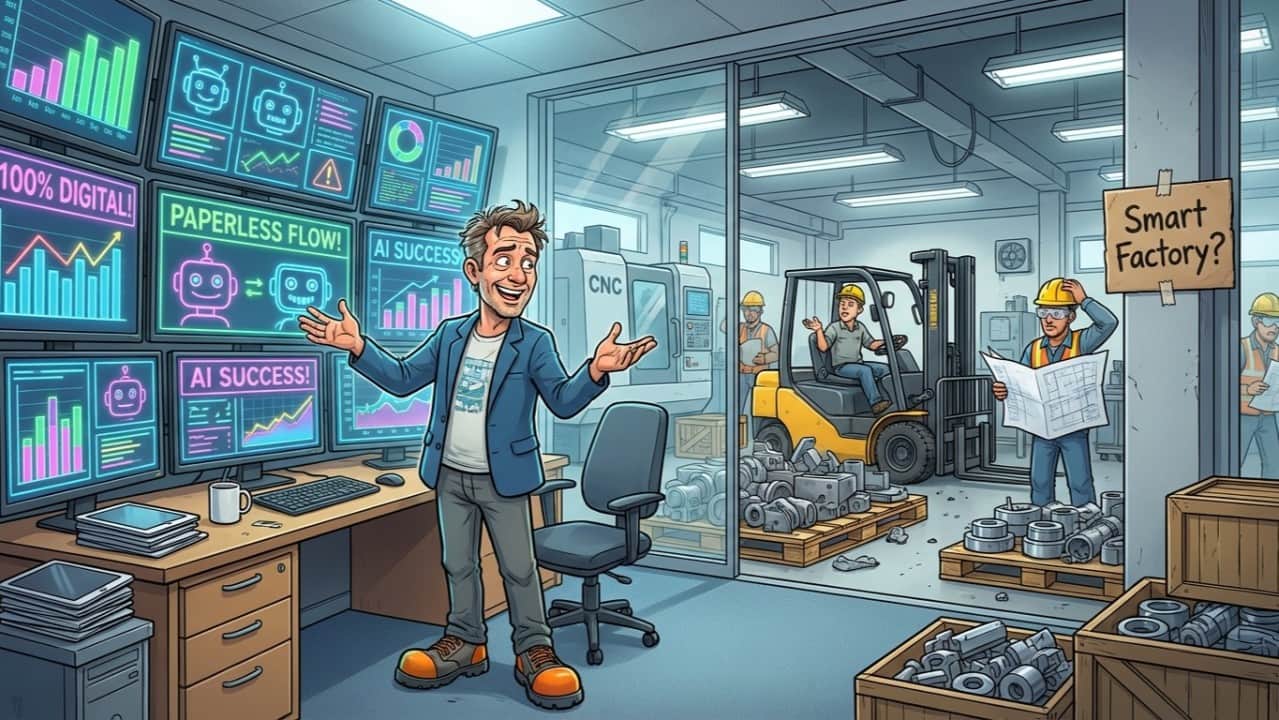
In 2025, green numbers finally appeared on our dashboard. People congratulated me.
"Nice, Wim – you made it. Profitability. Infinite runway. You're safe now."
But that's not how it felt.
It felt more like coming up for air after almost drowning, not like winning a race.
For most of the year, we were still in what every founder – and many factory owners – know too well: the danger zone. Cash runway shrinking. Costs under pressure. Investors cautious. Every decision suddenly has a very real, very short-term consequence.
And yet, in that pressure cooker, two things became painfully clear to me:
- AI really is a once-in-a-generation shift.
- Most of us are using it in a way that will make our factories feel smarter, but not act smarter.
That’s what I want to talk about – as a founder, but also as someone who spends his days with high-mix/low-volume metalworking companies trying to modernize without losing their soul.
The year of truth (and uncomfortable math)
2025 was our "year of truth" at Quotation Factory.
No hero story. Just reality.
We had to cut costs. Not because that looks good in a deck, but because we didn’t have a choice. New investment didn’t materialize as fast as we’d hoped. Like many of you, we discovered that what used to be “safe” – in my case, being a SaaS startup – suddenly wasn’t so safe anymore.
At exactly the same time, something else happened: AI quietly changed our productivity curve.
We went to a smaller team. We brought in more junior profiles.
Normally, that's a recipe for slowing down.
But with good training and serious use of AI, those juniors ramped up much faster than I've ever seen before. Our output stayed roughly the same, but our costs went down.
That was my first real, lived proof that AI isn't a toy. It's a genuine leverage point.
But – and this “but” is important – that leverage can also be pointed in the wrong direction.
“Every factory is a software company” – and the trap inside that sentence
I often say:
“Every manufacturing company is now a software company that happens to make physical things.” When I say that to owners of high-mix/low-volume shops, I see a lot of nodding.
Because you feel it every day: You’re dealing with more systems than ever. RFQs run through email, Excel, ERP, maybe a portal, maybe a quoting tool. Your best estimators are half human, half spreadsheet. Customers expect digital, instant, self-service – but your reality is drawings, PDFs, and tribal knowledge.
On top of that, 2025 was the year where everyone discovered they could build “software” with AI: Auto-generated apps Low-code workflows filled in by ChatGPT Dashboards everywhere Scripts, tools, helpers, automations It’s tempting. You can finally get things built without waiting for consultants or rare developers. It feels like freedom.
But here’s the trap:
We're using very powerful intelligence to generate very dumb software – and then we call the outcome "digitalization".
We’re still mostly doing the same thing we did 10–15 years ago: A database. A UI. Some logic. Pixels on a screen.
Just written faster, with AI instead of a developer.
It makes you feel smarter as the maker. But your factory? It often stays just as dumb.
Paperless is not the same as smart
There's a word I've started to dislike: paperless.
"Paperless factory." "Paperless office." "Paperless quoting."
Paperless tells you almost nothing about the intelligence of the system. It tells you you've replaced paper with a screen.
- Cosmetics, not cognition.
I see this in many high-mix/low-volume factories: You add software around the existing process.
-
You digitize forms, add a dashboard, add a planning board.
-
You throw in some AI to parse drawings or clean data.
-
Everyone feels modern.
-
But underneath, the decision-making logic is the same: Quoting still depends on a handful of experts.
-
Badly structured input still flows through the system.
-
Decisions are still made too late, with incomplete information.
-
The factory "feels" more digital, but the outcomes – margins, lead times, win rates – barely move.
-
So you end up with what I called in the livestream:
"A faster way to excel at mediocrity."
We're accelerating the wrong architecture.
What AI changed for us – and what it didn't
Back to my own story for a second.
- AI helped us survive 2025.
We trained juniors faster.
- We automated pieces of analysis, writing, communication.
- We used it in product work, in internal documentation, in sales.
It was a real productivity lever, not a gimmick.
- But here's what AI did not do for us: It did not magically tell us what kind of company we should be.
That part we had to learn the hard way: Who we really serve best (mid-size metalworking companies, high-mix/low-volume, 20–100 FTE).
- Which part of their world we can transform (inquiry → order, especially the front-end from drawings to accurate quotes).
- How to translate their messy commercial input into structured technical decisions.
AI is fantastic at amplifying whatever structure and intent you already have.
If your underlying process is vague, fragmented, and driven by hero-employees… AI just makes that vagueness faster and more complex.
If your process is well-designed, with clear decisions and data flows… AI becomes rocket fuel.
- That’s why I keep coming back to this idea:
The real bottleneck isn't lack of AI. It's the lack of an architecture that forces better decisions.
Smart factory ≠ dashboard factory
For 2026, I’ve set myself a very specific focus:
Redefine what a "smart factory" actually is – especially for high-mix/low-volume environments.
For me, a smart factory is not: A factory with more dashboards
- A factory with a prettier MES
- A factory where everyone is "paperless"
A smart factory is:
A factory that forces better decisions, based on what it learns every day.
That means: Structuring commercial + technical input at the source
- Turning RFQs and orders into machine-readable, comparable, learnable data
- Building a translation layer between customer language and factory reality
- Closing the loop between what you quoted, what you produced, and what you should do next time
This is the lens we use in Quotation Factory when we design our own systems and the digital “infrastructure” around quoting and CAM. Not just tools, but the plumbing that lets factories respond faster, learn from every job, and reduce dependency on one or two heroes in the office.
- Because if your factory can't learn, your AI won't save you.
Why incremental optimization is too slow
A final uncomfortable thought that grew on me in 2025: In many cases, you can't fix your existing factory by slowly improving it.
Not fast enough, anyway.
If you keep: Tweaking the old process
- Adding yet another system on the side
- Automating a few steps with AI here and there
…you might feel progress, but structurally you're still trapped.
- For some shops, the better move will be: Design a greenfield way of working – with learning and decision-making at the center.
- Build it in parallel, on a smaller scale, with a subset of customers or products.
- Scale that up as fast as you can until it replaces the old way.
That sounds radical. It is radical.
But it’s also how you escape the gravity of “we’ve always done it like this”.
AI is amazing – and soon it will be "just" software
I'm genuinely optimistic about AI.
We are at the beginning of an intelligence explosion. The tools are getting better every month. They will change how we design, plan, quote, train, and operate.
- But in your factory, something else will happen over time: AI will become "just" software.
It'll be another layer in your stack.
What will still matter then?
How you structure your decisions
- How you capture and use your data
- How you architect your processes
- How fast your factory can learn and adapt
That’s the “infrastructure for real smart factories” I want to explore in 2026: Not more apps. Not more dashboards. But a simpler, clearer backbone for high-mix/low-volume factories that want to think and act differently – not just look more digital.
An invitation for 2026
If you're a business owner of a high-mix/low-volume manufacturing company, my guess is that 2025 wasn't a hero year for you either.
Maybe it was your own "year of truth": Margin pressure
- Wage increases
- Talent shortages
- Customers expecting Amazon-level speed with job-shop complexity
In 2026, I’m going to use my livestreams, articles, and product experiments to work through one central question:
What does a genuinely smart factory look like when we start from decisions and learning – not from software categories?
If you're tired of just "optimizing" the old world and you're at least curious about redesigning it – I'd like you to follow along.
Not because I have all the answers, but because I think I've found some building blocks that are worth exploring together.
Connect with me, follow the journey, or just send me a message if you're thinking about a greenfield approach in your own factory.
Let's make sure that, when AI becomes "just software", your factory has become something much more: a system that learns and decides better every single day.