From Unified Namespace to a Manufacturing 'Belief System'
A research exploration into learning operations in High-Mix Manufacturing
Play with the ideas yourself: https://beliefsystem.lovable.app/
Over the past years, many of us in manufacturing have embraced Walker Reynolds’ Unified Namespace (UNS) as a foundational architectural pattern.
For good reason.
UNS gave us something manufacturing has lacked for decades: a clean, event-driven way to describe operational reality without embedding interpretation, logic, or judgment.
Machines, systems, and business processes publish events and state. Other systems react to those events. Data flows through decoupled, composable integrations instead of brittle point-to-point links.
That alone is a major architectural breakthrough.
But during a recent live stream, I shared a research experiment that intentionally builds on top of UNS - not to replace it, and not to extend it beyond its intent, but to explore a natural next question.
What Unified Namespace Solves - and What It Intentionally Does Not
Let's be precise.
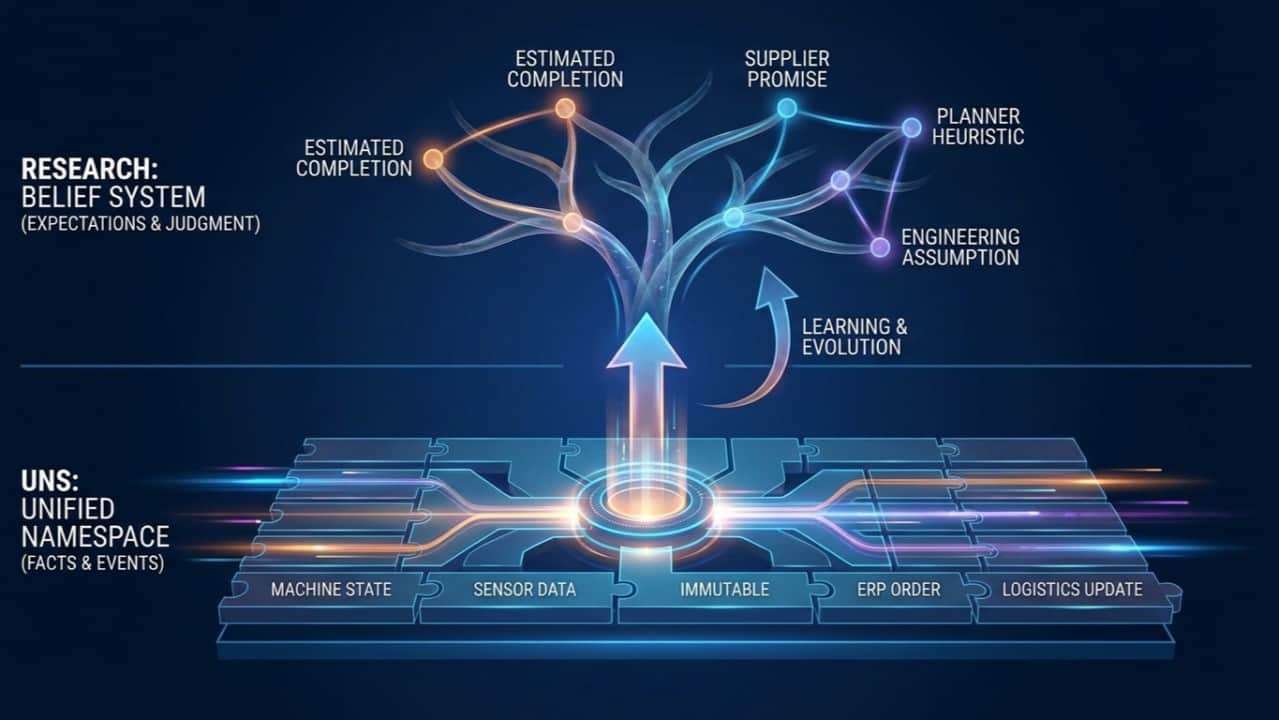
Unified Namespace is about facts. It is a shared, authoritative representation of what has happened and what is currently true.
Events and state are:
- Immutable or monotonic
- Time-ordered
- Free of embedded assumptions
This is exactly what makes UNS powerful.
Importantly, UNS is not limited to machines or the shop floor. It is an enterprise integration pattern spanning ERP, MES, quality, logistics, and business systems - allowing all of them to publish and consume operational state and events without tight coupling.
UNS is the ground truth layer. It tells us what happened.
- But UNS intentionally does not try to answer a different, equally important question
What did we believe was going to happen - and were we right?
That question sits outside the mandate of UNS by design.
The High-Mix Manufacturing Problem That **Never** Quite Goes Away
If you operate in High-Mix, Low-Volume manufacturing, this reality is familiar:
- Estimates become orders
- Orders become schedules
- Schedules are re-planned
- CAM simulations disagree with execution
- Machines behave differently than expected
- Suppliers are “usually” on time - until they aren’t
When things drift, we get:
- Alerts
- Red dashboards
- Late lists
- Exception reports
What we rarely get is epistemic clarity.
Specifically:
- What assumption failed?
- When was that belief formed?
- How far off was it?
- Was this a one-off or a pattern?
- Are we systematically optimistic, pessimistic, or inconsistent?
Most systems overwrite their own thinking the moment we replan.
Which means the very evidence required for learning disappears.
A Research Question, Not a Product Claim
The demo I walked through in the livestream is not a finished solution. It is a research environment.
The question we are exploring is simple, but foundational:
What if manufacturing systems explicitly preserved what they believed - not just what happened?
To explore this, we introduced a second explicit artifact alongside events.
Explicit Expectations as First-Class Artifacts
An expectation is a statement like:
"This work order should complete around 14:00." "This supplier delivery should arrive within this window." "This operation should take roughly this long."
These are not guarantees. They are beliefs - hypotheses about the future.
In the research model:
- Expectations are recorded explicitly
- They are versioned, never edited
- When beliefs change, history is preserved rather than overwritten
Just like events, expectations are treated as durable facts about what was believed at a point in time.
Events, Beliefs, and Judgment - Kept Deliberately Separate
Once you separate these concerns, a powerful but disciplined structure emerges:**
- Events – What actually happened (the domain of UNS)
- Beliefs (Expectations) – What we thought should happen, at that moment in time
- Judgment (Exceptions) – A derived signal when reality contradicts belief
This is fundamentally different from traditional alerts.
An exception now says:
"This specific belief was wrong - by this amount - in this context."
That is not noise. That is structured learning material.
Why This Is a Natural Extension of UNS - Not a Critique of It
UNS provides the memory of reality.
This research explores whether a belief-oriented layer can be one way to turn that memory into structured organizational learning.
Without UNS, this work makes no sense. Without a clean, authoritative event and state layer, beliefs cannot be falsified.
Think of it this way:
UNS preserves what happened. This research explores preserving what we believed - and learning from being wrong.
The layering is intentional. The responsibilities are non-overlapping.
Why This Matters Specifically for High-Mix Manufacturing
High-Mix environments don’t struggle because of poor execution. They struggle because assumptions are fragile.
You rarely have enough repetition for classical optimization. Instead, performance depends on:
- Engineering judgment
- Planner heuristics
- Experience-driven estimates
- “We think this will work” decisions
If those beliefs disappear every time you replan, improvement remains anecdotal.
By preserving expectations explicitly:
- Systematic optimism or pessimism becomes visible
- Structural issues can be separated from incidents
- Learning happens without blame
- Humans improve their judgment before automation or agents are introduced
This research is about learning first, not automation first.
UNS Positioning Disclaimer (Explicit)
To be absolutely clear: This work does not propose extending Unified Namespace with logic, planning, or judgment. It does not suggest that UNS is incomplete. UNS remains the neutral, authoritative integration backbone for operational reality. The concepts explored here live downstream of UNS, consume events and state from it, and deliberately preserve the architectural purity that makes UNS valuable in the first place.
Why This Is Still Research
No claims of universality are being made.
We are testing:
- Whether this mental model holds under real manufacturing complexity
- Whether it reduces noise instead of adding ceremony
- Whether the resulting insights are trusted by humans
- Whether it forms a safe foundation for future agent-based systems
That's why the demo is intentionally a playground, not a product.
An Open Invitation
If this resonates - or if it deeply irritates you - I’d genuinely like to hear from you.
If nothing else, UNS helped us agree on what happened. This research asks whether we can also agree on what we believed - and learn from it without rewriting history.
That question feels worth exploring.